

aka: when silence gets cocky and starts talking back.
Clairaudience is usually defined as “clear hearing,” or the psychic ability to hear information that does not have an ordinary physical source. That definition is technically useful, but it leaves out most of what actually matters when you are the person trying to figure out what the fuck just happened.
I experience clairaudience internally and externally. Sometimes it is a voice I recognize. Sometimes it is a voice I do not recognize. Sometimes it is one short sentence that drops into my mind while I am doing something completely unrelated. Other times I can have an actual dialogue. Songs are another major part of how it works for me, but even then the song does not always contain the message. Sometimes the song tells me who is communicating, and the message comes afterward.
The mistake is assuming there is one standard clairaudient experience. There isn’t. Psychic perception is observational, and no two people process information exactly the same way. The clairs give us useful language for describing parts of perception, but the minute we start turning those descriptions into universal laws, we have already wandered off into the weeds.
What Is Clairaudience?
Clairaudience is the auditory perception of psychic information. That information may be experienced as an internal voice, an external voice, individual words, complete sentences, sounds, music, song lyrics, or even a thought that seems to appear from nowhere and does not follow the person’s existing train of thought.
The important part is that clairaudience describes how part of the information is perceived. It does not automatically tell us where the information came from, what it means, or whether another clair is involved. That distinction becomes important because psychic perception rarely behaves like a clean little multiple-choice test.
How I Experience Internal and External Clairaudience
Most of my clairaudience happens internally. I can hear a sentence in my head and know that it did not develop from whatever I was consciously thinking about. I can also recognize specific voices, receive words from voices I do not recognize, or move into a longer dialogue depending on the situation.
External clairaudience feels different because the sound appears to occupy the physical space around me. I have experienced that too, but I do not consider external clairaudience more advanced, more legitimate, or somehow the deluxe psychic package. It is simply another way auditory information can be received.
The internal form is where people tend to second-guess themselves because the information appears inside conscious awareness. The logical brain immediately wants to claim jurisdiction over the whole damn thing. But the fact that information is consciously perceived through the brain does not mean the brain created it.
Clairaudience Can Sound Different From Person to Person
One of the things I have learned through my own intuitive development and through working with clients is that people do not experience psychic perception the same way. One person may recognize a clear internal voice. Someone else may receive only a few words. Another person may hear something and immediately feel a physical response, while someone else moves directly into an image or knowing.
That variation is why I do not teach clairaudience through rigid rules. I pay attention to what repeatedly happens for the individual.
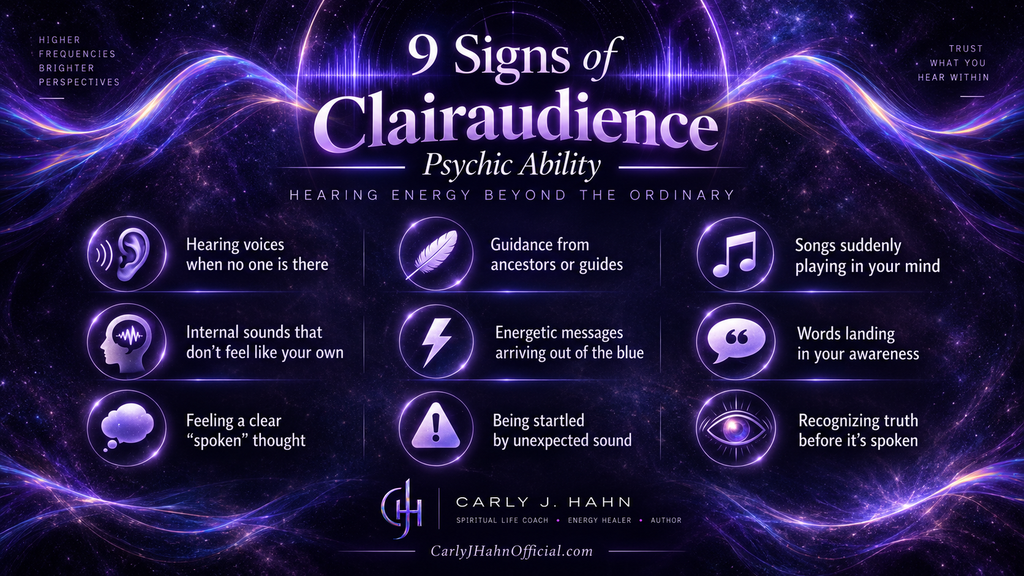
Common auditory experiences can include:
- words or short phrases that appear unexpectedly
- an internal voice that feels different from ordinary thought
- an external voice or sound without an obvious physical source
- recognizable voices
- unfamiliar voices
- songs, melodies, or lyrics appearing unexpectedly
- complete conversations or dialogue
- thoughts that interrupt an unrelated train of thought
These are observations, not a psychic diagnostic checklist. Having one of them happen once does not automatically answer what caused it. Patterns are what matter.
What Does Clairaudience Feel Like?
Clairaudience can feel subtle, obvious, surprising, familiar, confusing, emotionally charged, neutral, or completely meaningless when it first arrives. There is no single emotional tone that proves information is psychic, and I strongly disagree with the popular idea that genuine psychic information must always arrive calm, brief, positive, and wrapped in spiritual bubble wrap.
Sometimes I immediately understand what came through. Sometimes I understand enough to ask another question. And sometimes information arrives and I have absolutely no fucking clue what it means. The meaning may not become clear until another piece of information arrives hours or days later.
That uncertainty is part of intuitive development. You learn much more by documenting what happened than by forcing yourself to manufacture an interpretation because somebody told you psychics are supposed to know everything instantly.
When Clairaudience Comes Through as a Random Thought
Clairaudience does not always sound like a separate voice. Sometimes it comes through as a thought that appears so abruptly and so far outside your existing thought process that the interruption itself gets your attention.
I can be working on a website, completely absorbed in whatever I am building, and suddenly hear internally, “No, bitch, don’t do that.” Nothing in my conscious thought process was leading toward that sentence. It arrives first, and then my logical brain shows up afterward to investigate the crime scene.
That sequence matters. Information arrives. Then the brain interprets it.
The brain and nervous system are how we receive, process, and interpret psychic information. They are not the source of the information. Confusing the interpretation mechanism with the source is one of the reasons conversations about psychic perception get turned into psychological mush so quickly.
When Songs Carry Psychic Information
Songs are one of the clearest examples of why personal context matters more than generic spiritual symbolism. A song can contain information through its lyrics, emotional association, memory, or timing. It can also identify the person connected to the communication.
I have a specific example with my mother. I grew up singing “When the Saints Go Marching In” in the metaphysical church I attended with my parents, particularly my mother. Because of that history, the song has a very specific association for me.
I can be driving, thinking about something completely unrelated, and suddenly that song starts playing in my head. I know immediately who I associate it with. My mother. From there I can ask what the message is, and the communication may continue through her voice, short sentences, images, physical sensations, or another clair.
The song acts almost like psychic caller ID.
That is very different from searching Google for “spiritual meaning of When the Saints Go Marching In” and assuming somebody else’s interpretation explains my experience. Sometimes the personal association is the fucking meaning.
Does Clairaudience Work With Other Clairs?
Clairaudience can work with other forms of psychic perception within the same experience. Someone may hear information, see an image, feel something physically, smell something, or simply know another part of the message almost simultaneously. The clair labels describe how information is perceived, but they do not necessarily describe the entire experience.
This is one of the biggest issues I have with the way psychic perception is commonly taught. We take clairaudience, clairvoyance, clairsentience, claircognizance, clairalience, and the other forms of perception and put them into separate little boxes. Then people start worrying because their experience apparently failed to respect the organizational chart.
No clair works alone all the time.
How Multiple Clairs Can Build One Message
A psychic experience can move through several forms of perception in sequence. Clairaudience may begin the experience, while another clair provides the context or interpretation.
For example, I can hear something and then see an image. I ask what the image means and receive another sentence. Something happens in my body, and then I know how the pieces connect. In another situation, the image may arrive first and the clairaudience explains it afterward.
The sequence can look something like this:
- auditory information gets my attention
- an image or visual impression appears
- I ask for clarification
- another sentence comes through
- my body responds
- direct knowing connects the pieces
- additional information may arrive later
Trying to decide which single clair “caused” that experience misses the point. The information was built through multiple channels.
What Client Sessions Have Taught Me About the Clairs
Working with other people reinforced something I had already begun seeing in myself: psychic perception is individual. People may have a dominant way they perceive information, but that does not mean the rest of their perception shuts off.
This is one reason I am careful about telling someone, “You’re clairaudient,” and then acting as if that explains everything they experience. It gives us a useful starting point, but intuitive development is really about learning the person’s own pattern.
The client has to observe what happens when information arrives. What came first? What followed? What did the body do? Did another clair participate? Did the information make sense immediately or later? That is where their actual psychic language begins becoming visible.
How Do You Know If You Are Clairaudient?
You begin recognizing clairaudience by observing repeated patterns in how auditory information enters your awareness. One strange sentence, random song, ear tone, or unexpected thought is not enough to establish how your psychic perception works. Repetition and context tell you much more.
This is where most “signs you’re clairaudient” articles lose me. They start listing things like wanting quiet, having a strong internal dialogue, or getting songs stuck in your head. By that standard, half the population is apparently psychic before breakfast.
The useful question is not, “Do I have this symptom?” The useful question is, “What repeatedly happens when information comes through?”
What Should You Track During Intuitive Development?
Tracking psychic information is one of the most useful things someone can do during intuitive development because memory is extremely good at rewriting events after we know the outcome. Write down what happened before your logical brain has time to clean it up, explain it away, or turn it into a better story.
Start with the original experience and then document the surrounding context. I would track:
- what you were doing immediately beforehand
- what you were consciously thinking about
- whether you had asked a question
- exactly what information came through
- whether it felt internal or external
- whether you recognized the voice, song, or sound
- what happened in your body before, during, or after
- whether another clair became active
- what you thought the information meant at that moment
- what happened afterward
- whether later events changed or clarified the meaning
- whether the same pattern has happened before
Keep the original information separate from your interpretation. If you heard a sentence, write the sentence. If you saw an image, describe the image. Then write what you think it means underneath it.
That separation matters because sometimes your interpretation will be completely fucking wrong even when the original information was accurate.
Why the Body Is Part of Psychic Discernment
The body is the antenna. When information comes through, the physical response becomes another piece of information I can observe.
That might be tingling, pressure, a stomach drop, tightness, a shift in awareness, a sensation around the crown, a change in hearing, or no noticeable physical response at all. The point is not to assign a universal meaning to each sensation. The point is to notice what happens repeatedly in your body when specific types of information arrive.
This is also where nervous system awareness becomes useful without turning the nervous system into the explanation for psychic perception. The nervous system affects how information is received, processed, and interpreted. It can also affect whether someone becomes overwhelmed by what they are experiencing.
That still does not make the nervous system the source of the information.
How Can You Tell Clairaudience From Anxiety or Ordinary Thought?
The difference between clairaudience, anxiety, and ordinary thought cannot be reduced to “psychic information feels calm and anxiety feels scary.” Discernment comes from examining the full sequence around the experience, including what was happening beforehand, the state of the body, how the information arrived, and what happened afterward.
If I was already panicking, catastrophizing, physically activated, and mentally running through every possible disaster when another catastrophic thought appeared, I need to include that context. If I was sitting there peacefully working on something completely unrelated when an unexpected sentence interrupted my thoughts, that context matters too.
Neither situation is proof by itself. Observation gives me data. Repeated observation gives me patterns.
What Happened Before the Information Arrived?
The period immediately before information appears can tell you a lot. Were you already focused on the subject? Were you asking a question? Were you emotionally triggered? Were you thinking about something completely unrelated?
Surprise is one of the things I pay attention to because clairaudient information can interrupt my existing thought process. Something shows up that I was not consciously working toward.
But surprise is one part of the experience. Then I look at the body, the other clairs, the timing, and what happened next.
What Happens After Clairaudient Information Arrives?
Once information reaches conscious awareness, the logical brain begins interpreting it. This is where overthinking can enter and take something that arrived in three seconds and turn it into a forty-five-minute committee meeting.
Where did that come from?
Was that me?
What if I imagined it?
What does it mean?
Why would I hear that?
Do I need to do something?
The logical brain has many questions. Bless its fucking heart.
Sometimes analysis helps. Other times it contaminates the original information because the brain starts filling in details that were never actually received.
That is another reason I document the first piece before trying to understand it.
Does Clairaudient Information Always Make Sense Right Away?
Clairaudient information does not always make sense when it first arrives. Sometimes the meaning is immediate, while other information may remain unclear until another clair, event, conversation, or piece of context fills in what was missing.
This is completely normal in my experience. I have received information and known exactly what it meant. I have also received information that sat there making absolutely no sense until something happened later.
Not knowing yet does not make the information useless.
It means you do not know yet.
Why I Do Not Force Immediate Interpretation
One of the fastest ways to distort psychic information is to become uncomfortable with uncertainty and start making shit up to fill the gap. The brain wants completion. It likes explanations. Psychic information is under no obligation to provide all of the evidence at the same time.
If I do not understand something, I record it and leave it alone.
Later, another piece may arrive. I may see an image. Somebody may unexpectedly say something. A completely unrelated event may suddenly provide the context.
Then I can go back to the original record and see what actually came through before I knew the outcome.
That is how discernment becomes stronger over time.
How Do You Develop Clairaudience?
Clairaudience develops through observation, pattern recognition, practice, and learning how your own psychic perception communicates. Development is less about forcing yourself to hear something and more about becoming accurate at recognizing what is already happening.
The more carefully you track your experiences, the easier it becomes to see repetition. Certain songs may consistently connect with specific people. A particular physical response may accompany a certain type of information. Images may regularly come before auditory clarification. Random thoughts may appear in a recognizable way when you are focused on something completely unrelated.
Those patterns become your language.
Stop Trying to Copy Someone Else’s Psychic Perception
One of the worst things someone can do during intuitive development is memorize another person’s psychic meanings and then try to force their own perception to follow them.
Someone tells you right-ear ringing always means one thing. Tingling somewhere else means another. A particular song supposedly carries a universal message. Now instead of observing what your perception is actually doing, you are translating everything through a psychic dictionary written by a stranger.
No thank you.
Learn from other people’s experiences. Compare patterns. Ask questions. But keep coming back to your own observation.
That is where accuracy comes from.
What Years of Observation Have Taught Me About Clairaudience
The biggest thing clairaudience has taught me is that psychic perception is much more fluid than the labels we use to describe it. Clairaudience is real in my experience, but it does not live in isolation from the rest of my perception.
I hear things. I see things. I smell things. I feel information through my body. Sometimes I simply know. Sometimes one sense confirms another, and sometimes I receive something today that I will not understand until later.
That is why I am far more interested in teaching people how to observe than telling them exactly what every psychic experience means.
The label can help you recognize the channel. Your patterns teach you how your perception actually works.
That doesn’t make you dramatic. It makes you early. Some people see truth. Some feel it. Some smell it. Some know it. Some hear it before anyone’s ready to say it.
FAQ: Clairaudience Psychic Ability
What age can clairaudience first appear?
In my experience, clairaudience can appear in early childhood, often as hearing names, sounds, or guidance before a person has language to explain it. Many people recognize it later in life only after learning what it is.
Can clairaudience become stronger over time?
Yes. Clairaudience often becomes clearer as nervous system regulation, discernment, and self-trust improve. Growth usually brings precision rather than increased volume.
Can medications or substances affect clairaudience?
Some medications and substances can temporarily dull or distort perception by affecting the nervous system. This does not mean the ability is gone, only that the signal may be filtered.
Does environment affect clairaudience?
Yes. Noise levels, emotional atmosphere, group dynamics, and energetic environments can influence how clearly clairaudience is perceived. Crowded or chaotic spaces often increase interference.
Why do songs suddenly play in my head?
Songs often function as energetic carriers. Clairaudient music appears without conscious recall and is usually accompanied by immediate recognition rather than nostalgia. Music bypasses analytical filtering, making it an efficient communication channel.
Can clairaudience fade and come back later?
Yes. Many people experience periods of quiet followed by reactivation. This usually reflects life changes, nervous system shifts, or changes in focus rather than loss of ability.
Is clairaudience dangerous?
No. Clairaudience itself is not dangerous. Difficulty usually arises from misunderstanding the experience or lack of grounding. When discernment and nervous system regulation are present, clairaudience functions as information awareness, not loss of control.
Why does clairaudience get louder sometimes?
Volume and clarity are influenced by nervous system regulation. When overstimulated or exhausted, perception may feel louder. When grounded and regulated, the signal becomes cleaner rather than more frequent.
How is clairaudience different from intuition?
Intuition usually arrives as feeling or knowing. Clairaudience arrives as sound. Intuition unfolds gradually, while clairaudience interrupts awareness with direct auditory information.
Can everyone develop clairaudience?
Perceptual sensitivity varies by individual. While awareness can strengthen through regulation and discernment, not everyone experiences clairaudience in the same way or to the same degree.
What is the most common sign of true clairaudience?
Recognition. The immediate knowing that the sound did not originate from conscious thought is the most consistent indicator across experiences.
Thank you for viewing my What is Clairaudience article.